
AgenticFlow.ai
AI-Powered Marketing Workflow Automation 300+ pre-built workflows for content creation, Bring Your Own LLM key + secure GPT‑4, Gemini, Claude
Free
Features
Powerful no-code automation platform.
Multi-agent orchestration for complex tasks.
Responsive, hands-on founder and support.
Rapid updates and roadmap commitment.
Detail
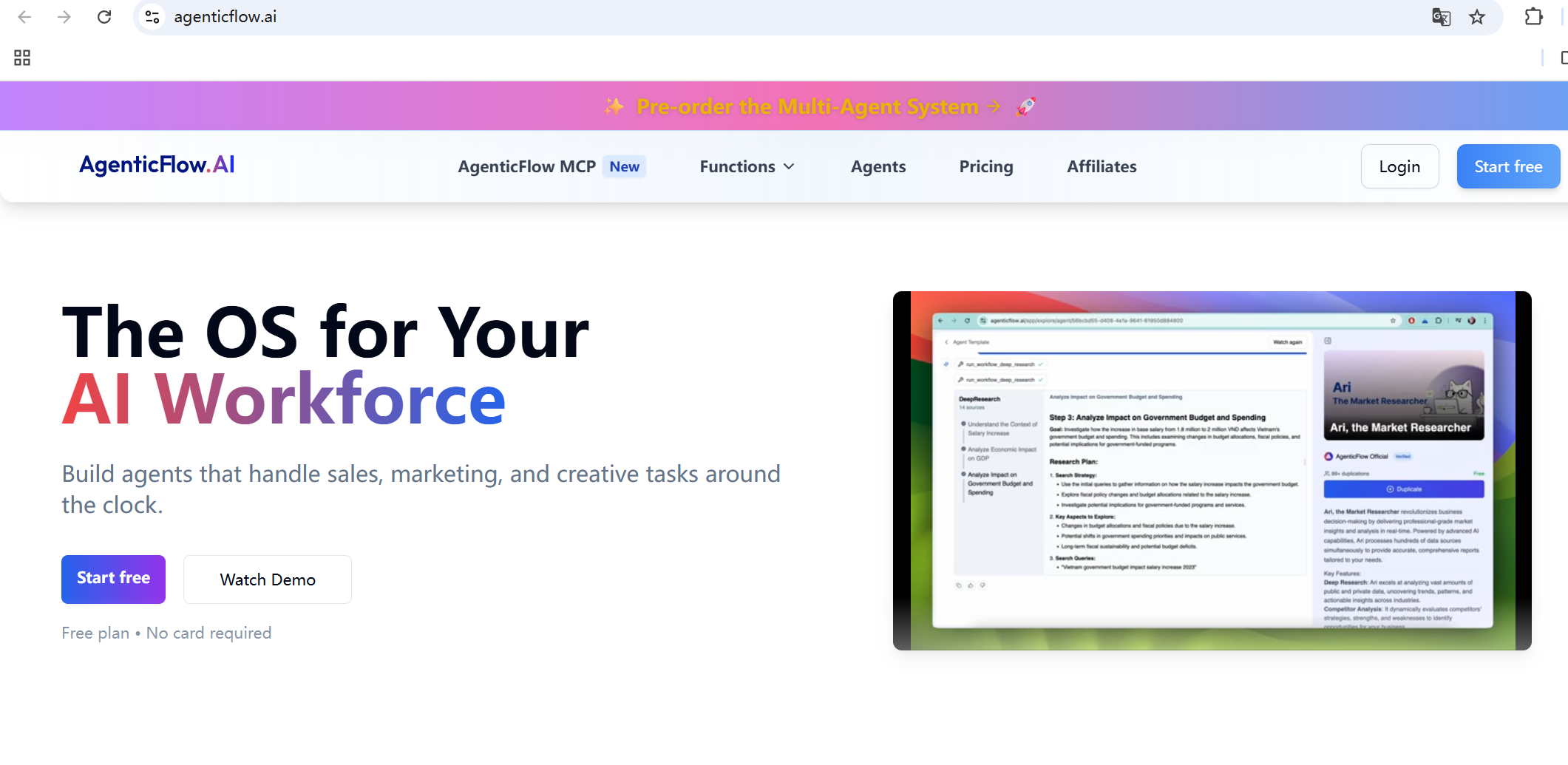
AgenticFlow.ai: An Intelligent Multi-Agent Collaboration and Workflow Automation Platform
AgenticFlow.ai is an AI tool focusing on "multi-agent collaboration" and "complex workflow automation". Its core positioning is to help individual users and enterprise teams break the functional limitations of single AI tools through visual orchestration, modular agent combination, and cross-scenario task linkage, integrating scattered AI capabilities into an "end-to-end" automated solution. It is particularly proficient in handling complex tasks that require multi-step and multi-tool collaboration, significantly reducing the cost of manual intervention and improving the efficiency and accuracy of task processing.
I. Core Advantages: Three Differentiated Competitive Strengths
Different from traditional single-function AI tools, AgenticFlow.ai builds its core value around three dimensions: "collaboration", "automation", and "flexibility", accurately addressing the pain points of users in complex task processing:
- Multi-Agent Collaboration: Breaking Tool Barriers and Achieving Capability Complementation
It supports the access and combination of different types of "Agents"—including built-in general-purpose Agents (such as text generation, data analysis, and image processing Agents), professional Agents connected via third-party APIs (such as ChatGPT, Claude, and MidJourney Agents), and user-defined "exclusive Agents" (such as customer service Agents trained based on enterprise private data and industry compliance analysis Agents). Through logical linkage between Agents (e.g., "Data Extraction Agent → Analysis Agent → Report Generation Agent"), complex tasks that cannot be completed by a single tool are accomplished. For example, "extracting sales data from multiple Excel spreadsheets → automatically analyzing year-on-year/sequential trends → generating a visual report and sending it to a designated email address".
- Visual Workflow Orchestration: No-Code Operation for Rapid Construction of Automated Processes
It provides a "drag-and-drop" visual editor. Without programming experience, users can intuitively build automated task processes by dragging "Agent modules", "conditional judgment nodes", and "data flow links". For instance, marketers can quickly configure a fully automated process of "receiving customer inquiry emails → calling an NLP Agent to extract key needs → matching a product knowledge base Agent to generate a reply → automatically feeding back via an email sending Agent", eliminating the need to manually handle each inquiry email. It also supports process saving, reuse, and sharing, allowing teams to accumulate standardized automated templates and improve collaboration efficiency.
- Dynamic Task Adaptation: Adjusting Strategies in Real-Time to Respond to Complex Scenario Variables
It has "dynamic decision-making capabilities" and can adjust process logic according to real-time variables during task execution. For example, in the "customer complaint handling process", if the NLP Agent identifies that the complaint content involves "product quality issues", it will automatically trigger the "Quality Department Connection Agent"; if it is identified as a "logistics delay issue", it will jump to the "Logistics Tracking Agent", without the need for manual classification. In addition, it supports setting "exception handling nodes" (such as automatic retry when a task fails and triggering manual reminders after timeout) to ensure the stability and fault tolerance of the automated process.
II. Core Function System: Four Modules Supporting Full-Scenario Automation
With "Agents" as the core, AgenticFlow.ai is equipped with three supporting modules: "workflow orchestration", "data management", and "integration capabilities", forming a functional ecosystem covering the entire cycle of "task decomposition - execution - monitoring - optimization":
1. Agent Hub: A Rich Repository of Agent Resources
It provides three types of Agents—"built-in", "customizable", and "third-party accessible"—to meet the needs of different scenarios:
- Built-in Basic Agents: Cover high-frequency basic tasks, such as Text Summarization, Data Cleaning, Format Conversion (e.g., PDF to Word, spreadsheet to visual chart), and Speech-to-Text. They can be used directly without additional configuration;
- Industry-Specific Agents: Optimized for the needs of specific industries. For example, the "Competitor Price Monitoring Agent" in the e-commerce field (automatically crawling competitor platform prices and generating comparison tables), the "Homework Grading Agent" in the education field (supporting automatic scoring of objective questions and keyword-based scoring of subjective questions), and the "Contract Clause Extraction Agent" in the legal field (automatically identifying key clauses in contracts such as validity period and breach of contract liability);
- Customizable Agents: Support users to create exclusive Agents based on their own data or rules. Through a "no-code training panel", users can upload sample data and set judgment logic (e.g., "trigger the refund process when the customer inquiry content includes 'refund'") to adapt to the personalized needs of enterprises or individuals;
- Third-Party Agent Access: Seamlessly connect to the Agent capabilities of mainstream AI tools through API interfaces, such as accessing ChatGPT's dialogue generation capabilities, MidJourney's image generation capabilities, and Google Sheets' data calculation capabilities, enabling "unified scheduling of multi-platform AI resources using AgenticFlow".
2. Flow Builder: A Visual Process Design Tool
The core function is "drag-and-drop process construction", with key features including:
- Rich Nodes: Provide "Agent nodes" (for executing specific tasks), "conditional judgment nodes" (e.g., "if-else" logic for branch execution based on task results), "loop nodes" (e.g., "cyclically calling Agents when processing 100 pieces of data in batches"), and "delay nodes" (e.g., "sending a notification 1 hour after task execution"), meeting the needs of complex process design;
- Real-Time Preview and Testing: Support real-time preview of process logic while building. Users can input simulated data through the "test mode" to verify whether the process is executed as expected and promptly identify and correct logical vulnerabilities;
- Version Management: Automatically save historical versions of processes and support rolling back to previous valid versions to avoid process failure due to modification errors;
- Template Library: Provide a large number of ready-made workflow templates, such as the "Social Media Content Automatic Publishing Process" (text generation → image matching → multi-platform synchronous publishing), "Monthly Financial Report Automation Process" (data import → calculation → report generation → email distribution), and "Customer Lead Follow-Up Process" (lead import → intelligent classification → automatic sending of follow-up emails → recording follow-up status). Users can directly reuse or fine-tune the templates, significantly reducing the construction cost.
3. Data Hub: Full-Process Data Flow and Storage
It ensures the smooth flow and secure management of data during Agent collaboration:
- Data Connectors: Support connection to a variety of data sources, including local files (Excel, CSV, TXT), cloud storage (Google Drive, Dropbox, OneDrive), enterprise databases (MySQL, PostgreSQL), and SaaS platforms (such as Salesforce customer data and Shopify e-commerce data), enabling "direct data capture from data sources into the automated process";
- Data Caching and Sharing: Intermediate data generated in the process (such as spreadsheets and summary texts processed by Agents) can be temporarily cached for reuse by subsequent nodes, avoiding repeated data processing; it also supports intra-team data sharing. For example, a customer data spreadsheet created by User A can be authorized for direct use by User B's workflow;
- Data Security Assurance: Adopt End-to-End Encryption to store sensitive data and support setting data access permissions (e.g., "only the process creator can view raw data, and team members can only view processed results"), complying with data compliance requirements such as GDPR and CCPA.
4. Integration & Monitoring: Ensuring Stable Process Operation and External Linkage
- External Tool Integration: Support linkage with daily office tools, such as automatically synchronizing process results to Slack/Teams group chats, sending notifications to WeChat/DingTalk, and updating Google Calendar/Outlook schedules, ensuring users can timely obtain task progress; it can also trigger external tool actions, such as automatically creating tasks in Asana/Trello and updating customer follow-up status in HubSpot after process completion;
- Process Monitoring Dashboard: Real-time display the status of all running processes (e.g., "Running", "Completed", "Failed") and provide detailed execution logs (including the start time, processing duration, output results, and error reasons of each node), facilitating users to troubleshoot process failures;
- Performance Analysis: Automatically count the average execution time, success rate, and number of Agent calls of processes, generate a "Process Efficiency Report", and help users identify inefficient links (e.g., "an Agent has an excessively long average processing time") to optimize process design.
III. Typical Application Scenarios: Covering Multiple Fields for Individuals and Enterprises
The flexibility of AgenticFlow.ai makes it suitable for personal efficiency improvement and enterprise team collaboration. The following are the core application scenarios:
1. Personal Efficiency Scenarios: Automating the Handling of Repetitive Tasks
- Content Creation Assistance: Build a process of "topic selection → material collection → first draft generation → typesetting". For example, "call the 'Trend Analysis Agent' to obtain industry hotspots → use the 'Material Crawling Agent' to collect relevant cases → generate a first draft of the article through the ChatGPT Agent → call the 'Typesetting Agent' to convert it into the official account format", significantly shortening the content creation cycle;
- Daily Task Management: Such as "email automation processing" (call the "Email Extraction Agent" to filter important emails → use the "Text Analysis Agent" to extract to-do items → automatically synchronize to the Todo list tool and set reminders) and "bill organization" (crawl bill data from bank emails/APPs → call the "Data Classification Agent" to classify by consumption type → generate a monthly consumption report).
2. Enterprise Team Scenarios: Improving Cross-Departmental Collaboration Efficiency
- Marketing Operations: "Omni-Channel Marketing Content Distribution Process"—call the "Copywriting Generation Agent" to create copy suitable for different platforms (WeChat, Weibo, Xiaohongshu) → use the "Image Matching Agent" to match corresponding style images for each copy → send synchronously to various channels through the "Multi-Platform Publishing Agent" → call the "Data Statistics Agent" to collect the page views/conversion rates of each platform and generate an effect report;
- Human Resources: "Employee Onboarding Process Automation"—after new employee information is entered into the system, the process is automatically triggered: call the "Document Generation Agent" to create an onboarding manual → use the "Email Agent" to send the manual and onboarding reminders → schedule department training meetings through the "Schedule Agent" → call the "Permission Configuration Agent" to activate office system permissions for new employees, eliminating the need for HR to manually coordinate multiple departments;
- Customer Service: "Intelligent Customer Service Ticket Handling Process"—after a customer submits a ticket, the "NLP Agent" automatically identifies the problem type and urgency level → for general problems, directly call the "Knowledge Base Agent" to generate a reply and send it; for complex problems, automatically assign them to the corresponding customer service specialist, and at the same time synchronize the customer information and historical communication records in the ticket to the customer service workbench, improving the response efficiency.
3. Professional Field Scenarios: Adapting to In-Depth Industry Needs
- E-Commerce Operations: "Competitor Analysis and Pricing Process"—at a fixed time every day, call the "Web Crawling Agent" to obtain the product prices and promotional activities of competitor platforms → use the "Data Comparison Agent" to analyze the price difference and advantage differences between the company's products and competitors' products → generate decision suggestions according to preset rules (e.g., "trigger a price adjustment reminder when the competitor's price is 5% lower than the company's price") and send them to the operation team;
- Scientific Research Field: "Literature Analysis and Data Organization Process"—after uploading multiple scientific research literatures, call the "Text Extraction Agent" to extract the research methods, conclusions, and data charts of each literature → use the "Literature Classification Agent" to group them by research direction → summarize the key data into a comparison table through the "Data Integration Agent", assisting researchers in quickly organizing research progress.
IV. Technical Features: Supporting an Efficient and Stable Automated Experience
AgenticFlow.ai optimizes around "efficiency", "security", and "compatibility" at the technical level. The core technical highlights include:
- Low-Code/No-Code Architecture: Based on visual interaction and modular design, it lowers the threshold for using AI automation, allowing users without technical backgrounds (such as marketers, HR personnel, and teachers) to quickly get started with building complex processes;
- Intelligent Task Decomposition Algorithm: For complex tasks (e.g., "writing an industry annual report"), it can automatically decompose them into sub-steps such as "data collection → data cleaning → trend analysis → report framework construction → content filling → format optimization" and recommend suitable Agent combinations to assist users in quickly designing processes;
- Elastic Computing Power Scheduling: When users run multiple processes simultaneously or call high-computing-power Agents (such as image generation and big data analysis), the system automatically allocates computing power resources to avoid process lag due to insufficient resources and ensure the smoothness of multi-task parallel processing;
- Open API Ecosystem: Provide a complete developer API, supporting enterprises to embed the automation capabilities of AgenticFlow into their own systems (such as enterprise ERP and CRM), enabling "triggering automated processes within the system" (e.g., automatically triggering the follow-up process of AgenticFlow when the customer status in CRM becomes "high-intention").
V. Target Users and Value Summary
Target User Groups
- Individual Users: Freelancers, students, and office workers who need to handle a large number of repetitive tasks (such as content creation, data organization, and email management). They can improve personal efficiency and reduce the time spent on trivial tasks through automation;
- Small and Medium-Sized Enterprise Teams: Marketing, HR, and customer service teams that lack professional technical teams but need to realize business process automation. They can quickly build automated solutions adapted to their business without development, reducing operating costs;
- Departments of Large Enterprises: Departments with frequent cross-departmental collaboration and complex business processes (such as e-commerce operation departments and customer service centers). They can uniformly schedule multi-platform AI resources through AgenticFlow, break down data and tool barriers between departments, and improve cross-departmental collaboration efficiency.
Core Value Summary
AgenticFlow.ai is not a simple "collection of AI tools", but an "connector of AI capabilities and commander of automation"—it breaks the functional boundaries of single AI tools through visual orchestration, turning "multi-agent collaborative processing of complex tasks" from a technical concept into a quickly usable solution. Its core value lies in: lowering the threshold for using AI automation (no programming required), improving task processing efficiency (reducing manual intervention), and enhancing process flexibility (adapting to personalized needs), ultimately helping users free themselves from "repetitive labor" and focus on more creative and decision-making core work.
Related Tools

Fanvue AI
The #1 AI-Powered Platform for Creators Turn Your Creativity Into Cash with Fanvue Turn Followers into Income
Paid

GPTZero
AI detection for educators Detect AI-written content within seconds Trained on multiple AI models
Paid

OutfitSwap.ai
Transform Outfit styles with AI Tech Realistic edits with diverse outfit options! Generates output in just a few Seconds
Free

X Pictures
Craft your uncensored masterpieces with cutting-edge AI Start for Free Delivers privacy-focused, high-quality explicit art!
Paid