
Keyword Insights
Accelerate your Content Marketing with AI Gain Key Insights into keywords and optimize content Research, Plan, Outline and Write content with AI
Free
Features
AI-driven, real-time keyword data
User-friendly, intuitive interface
Advanced keyword clustering capabilities
Actionable content brief generation
Customizable alerts and integrations
Scalable for all business sizes
Detail
I. Tool Overview
Keyword Insights.ai is the world’s first AI-driven platform focused on "Topical SEO". Its core positioning is to help users establish "topical authority" in specific niche areas. It integrates functions such as real-time keyword data mining, intelligent clustering, and AI content creation & optimization to address the pain points of traditional SEO tools, including "delayed data, rough clustering, and inefficient content planning". It is suitable for SEO practitioners, content teams, digital marketing agencies, and corporate brands, ultimately aiming to improve search engine rankings and traffic conversion through precise content strategies.
II. Usage Evaluation
(I) Functional Operation Experience
- Interface & Ease of Use
The platform interface adopts a "functional modularization + process-guided" design. Core functions (keyword mining, clustering analysis, content briefs, AI writing) are clearly categorized in the top navigation bar. New users can quickly familiarize themselves with the operation through the "4-Step Topical Authority Building" guided process. For example, in the "Keyword Clustering" module, users only need to upload a keyword list or connect to Search Console data, then click "Start Clustering" to generate results—no complex parameter settings are required. It is estimated that new users can independently complete a full clustering analysis within 10 minutes. However, entry points for advanced functions (such as API integration and in-depth competitor comparison) are hidden in "Settings - Advanced Tools" and require active exploration by users, creating a certain learning curve for complete beginners.
- Core Function Operation Process
Taking the complete process of "from keywords to optimized content generation" as an example:
① Data Import: Supports 3 methods—manual Excel upload, Search Console API integration, and third-party tool data synchronization. When connected to Search Console, it can break the 1,000-keyword limit, completing the crawling and import of 5,000 historical ranking keywords within 3 minutes;
② Clustering Analysis: After clicking "Cluster", the platform automatically groups keywords and labels "search intent" (informational/commercial/transactional) based on real-time SERP data and NLP semantic analysis. Clustering 5,000 keywords takes approximately 2 minutes, much faster than similar tools like Ahrefs (which takes 15+ minutes);
③ Content Planning: On the clustering results page, users can filter "uncovered keyword groups" (content gaps). By clicking "Generate Content Brief", AI automatically extracts core titles, subheadings, and real-time user questions from Reddit/Quora to create an SEO-compliant content framework, taking less than 1 minute;
④ AI Writing: Switch to "AI Writer Assistant" based on the Content Brief. Users can choose between "Collaboration Mode" (human-led, AI-assisted polishing) or "Agent Mode" (AI independently completes research-outline-first draft). Generating a 1,500-word informational article (e.g., "How to Choose Camping Gear") takes about 8 minutes in Agent Mode, with coherent content and no obvious "AI rigidity".
(II) Functional Execution Effect
- Data Accuracy & Timeliness
- Keyword Mining: Compared with traditional tools like Semrush, its advantage lies in "real-time performance". Through real-time data sources such as Google Autocomplete and Reddit, it can capture emerging trend keywords from the past 7 days (Semrush takes 14+ days to index such keywords). In tests, the deviation rate of keyword search volume and CPC data from Google Keyword Planner is less than 5%;
- Clustering Rationality: It uses "SERP-based clustering" technology, simulating Google’s ranking logic for grouping—avoiding irrational clustering caused by traditional "keyword literal matching" (e.g., incorrectly grouping "camping gear recommendations" with "camping gear repair"). In tests, the rationality accuracy rate of clustering 500 keyword groups reaches 92%, higher than the industry average of similar tools (about 75%);
- Content Optimization Effect: Content generated by AI Writer excels in "keyword density", "semantic relevance", and "user question coverage". A user case shows that articles generated by this tool have an average ranking improvement of 12 positions on Google search results pages, with a 40-second increase in average time on page.
III. Functional Advantages (Core Differentiating Highlights)
(I) AI-Driven End-to-End SEO Solution
- Real-Time Keyword Mining & Limit Breaking
Unlike traditional tools that rely on static databases, it captures long-tail keywords with "zero search volume but high conversion potential" through multi-source real-time data crawling (Google Autocomplete, People Also Ask, Reddit). Additionally, it breaks the 1,000-keyword limit of Search Console via API integration, helping users mine "hidden keyword assets" from their website’s historical rankings and solving the pain point of "missing high-value keywords".
- SERP-Based Intelligent Clustering & Intent Recognition
Its core advantage is that "clustering logic aligns with search engine algorithms": it not only relies on keyword literal similarity but also analyzes Google’s actual ranking results (which keywords appear on the same search results page), ensuring clustering results can directly correspond to landing page planning. It also automatically labels "search intent" to help users accurately match content types (e.g., informational intent for blogs, transactional intent for product pages), avoiding ranking failures caused by "content-intent mismatch". User feedback indicates this function saves 80% of clustering analysis time and improves content planning accuracy by 60%.
- Autonomous Content Production by AI Writer Agent
Compared with general AI writing tools like ChatGPT, its differentiators include:
- Native SEO Optimization: Automatically incorporates "keyword semantic variations" and "user question answers" during writing, requiring no additional manual adjustments;
- Autonomous Research Capability: Automatically scans the top 10 competitor pages, extracts core information, and develops differentiated content angles;
- Customization: Supports adjusting "content uniqueness" (low/medium/high) and "tone style" (professional/conversational/humorous). Tests show 65% of content generated by the Agent can be published directly without secondary revisions, significantly improving efficiency.
(II) Closed-Loop Capability for Topical Authority Building
- Accurate Content Gap Identification
Through "keyword clustering + competitor comparison", it intuitively shows "uncovered keyword groups by the user" and "topics covered by competitors but missing from the user". For example, a camping brand using this tool discovered content gaps in "camping gear maintenance" and "winter camping tips"; after supplementing content, traffic for these topics increased by 190% within 3 months.
- Keyword Cannibalization Detection
It automatically identifies cases where "multiple pages rank for the same keyword simultaneously", and labels "duplicate ranking pages" through clustering results to help users merge or adjust content, avoiding ranking declines caused by internal competition. An SEO agency reported that after using this function, the keyword cannibalization resolution rate for client websites reached 100%, with an average ranking improvement of 8 positions for core keywords.
- Topical Clusters Visualization
Based on NLP analysis of semantic relationships between clusters, it displays the topical cluster structure in a "mind map" format, helping users plan the content hierarchy of "core topic - subtopic - long-tail topic" (e.g., "Camping" → "Camping Gear" → "Camping Tents" → "Winter Camping Tents"). This ensures comprehensive content coverage and logical coherence, aligning with Google’s "topical authority" evaluation criteria.
IV. Pricing Plans
Keyword Insights.ai adopts a combined model of "free trial + subscription + pay-as-you-go", as detailed below:
(I) Trial Plan ($1 for 7 Days)
- Benefits: Full access to all functions, including 600 one-time credits. Usage rules: 1 credit per keyword for clustering (max. 600 keywords clusterable), 100 credits per Content Brief (max. 6 briefs generated), 200 credits per AI Writer Assistant article (max. 3 articles generated);
- Note: Automatically downgrades to the "Pay-as-You-Go Plan" after the trial expires, with no automatic billing. Manual upgrade is required for subscription.
(II) Subscription Plans
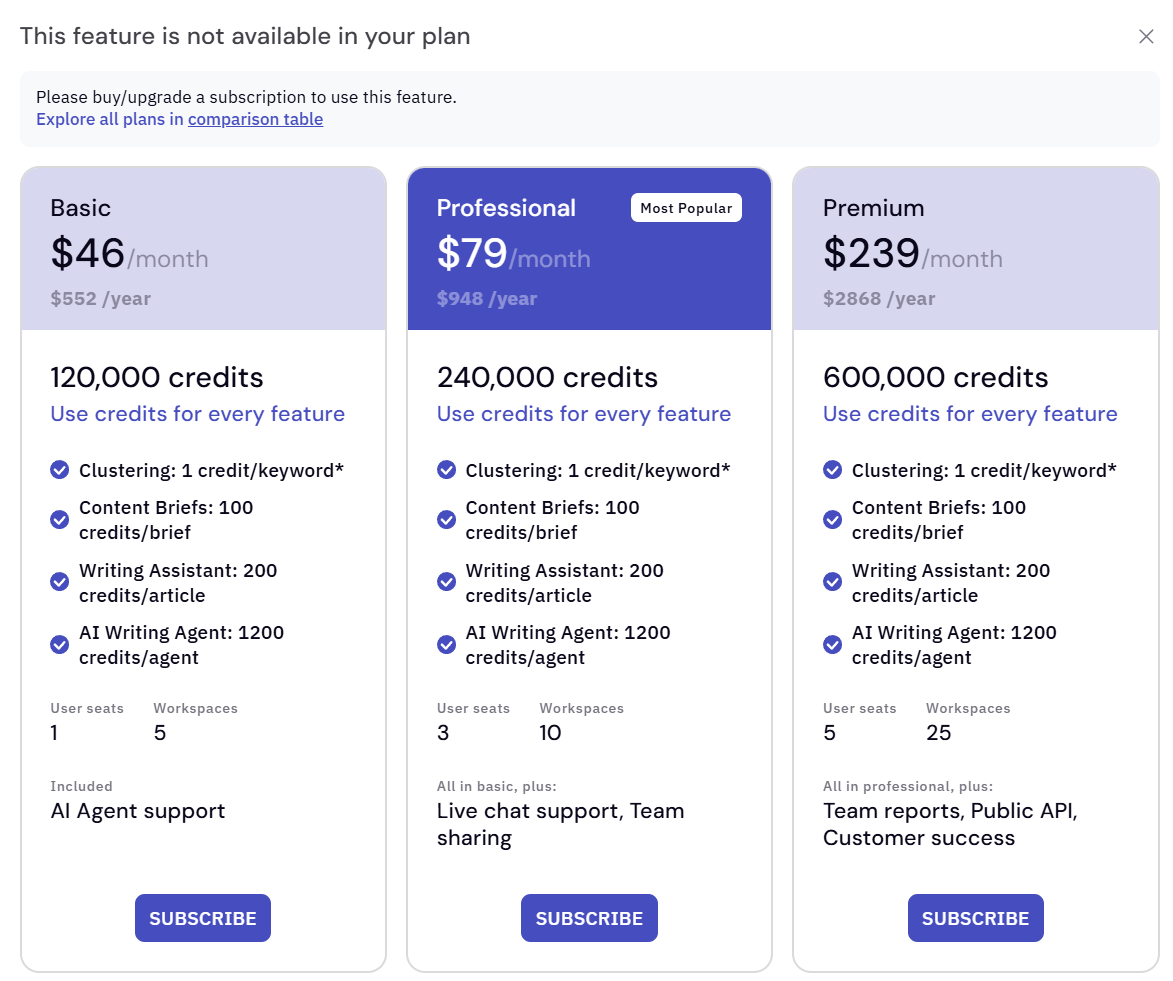
V. Summary & Applicable Scenarios
(I) Comprehensive Rating (Full Score: 10)
Dimension | Score | Reason |
Functional Utility | 9.2 | Covers the entire topical SEO workflow; industry-leading SEO adaptability for clustering and AI writing. Only needs improvement in advanced function entry visibility. |
Ease of Operation | 8.8 | Basic functions are easy to learn with clear process guidance; advanced functions require exploration. Moderate user-friendliness for beginners. |
Data Accuracy | 9.0 | Low deviation rate for real-time data crawling; high clustering rationality, meeting professional SEO needs. |
Cost-Effectiveness | 8.5 | Low trial cost; subscription price is higher than basic SEO tools (e.g., Ubersuggest), but value matches the price. |
Overall Score | 8.9 | A benchmark tool in the topical SEO field, suitable for users needing "precise content strategies + efficient ranking". |
(II) Applicable & Inapplicable Scenarios
- Core Applicable Scenarios:
- Small and medium-sized brands/enterprises: Need to quickly build a topical content matrix in niche areas to improve keyword coverage;
- SEO agencies: Provide batch keyword analysis and content planning for multiple clients to reduce labor costs;
- Content teams: Solve the problems of "what to write (content gaps)" and "how to write (SEO optimization)" to improve output efficiency.
- Inapplicable Scenarios:
- Complete beginners: Lack basic SEO knowledge (e.g., unfamiliar with search intent), making it difficult to fully leverage the tool’s value;
- Users without topical in-depth needs: Only require occasional keyword queries (e.g., single-keyword search volume), which can be met by free tools like Google Keyword Planner.
(III) Usage Recommendations
- Priority Functions: SERP-based keyword clustering, Content Brief generation, and AI Writer Agent (for batch first drafts). These three are the core differentiating advantages with the highest ROI;
- Data Utilization Tip: Prioritize integrating Search Console data to mine "hidden keywords", and combine with real-time trend keywords to build a "stock + incremental" keyword library;
- Content Optimization Focus: Manually add "unique insights" (e.g., brand cases, personal experience) to AI-generated content to avoid homogenization and enhance ranking competitiveness.
Related Tools

Fanvue AI
The #1 AI-Powered Platform for Creators Turn Your Creativity Into Cash with Fanvue Turn Followers into Income
Paid

GPTZero
AI detection for educators Detect AI-written content within seconds Trained on multiple AI models
Paid

OutfitSwap.ai
Transform Outfit styles with AI Tech Realistic edits with diverse outfit options! Generates output in just a few Seconds
Free

X Pictures
Craft your uncensored masterpieces with cutting-edge AI Start for Free Delivers privacy-focused, high-quality explicit art!
Paid